

Have you ever wondered what it’s like to zoom through space, hopping from one planet to another? Buckle up, because understanding the planets in our solar system is about to become an out-of-this-world adventure! From the fiery surface of Mercury to the icy rings of Saturn, each planet has its own quirky personality that’s just waiting to be explored.
Overview of Planets
The solar system contains eight distinct planets. Mercury, the closest planet to the Sun, features a rocky surface and extreme temperatures. Venus, second in line, boasts thick, toxic clouds that trap heat, making it the hottest planet. Earth, known for its life-sustaining atmosphere and abundant water, is the third planet.
Mars, the fourth planet, garners interest due to its red appearance and evidence of past water. Jupiter, as the largest planet, captures attention with its Great Red Spot, a massive storm larger than Earth. Saturn, famous for its spectacular rings, holds a unique position as the sixth planet.
Uranus, the seventh planet, stands out due to its blue-green hue and unusual tilt, causing it to rotate on its side. Neptune, the farthest planet from the Sun, is known for its deep blue color and strong winds. Each planet plays a role in the vast expanse of space, contributing to the solar system’s intricate dynamics.
Their diverse characteristics and distances from the Sun create fascinating contrasts and intriguing mysteries for explorers and astronomers alike. Active research continues to unveil more about these celestial neighbors, captivating the imaginations of young learners eager to discover the wonders of outer space.
The Solar System
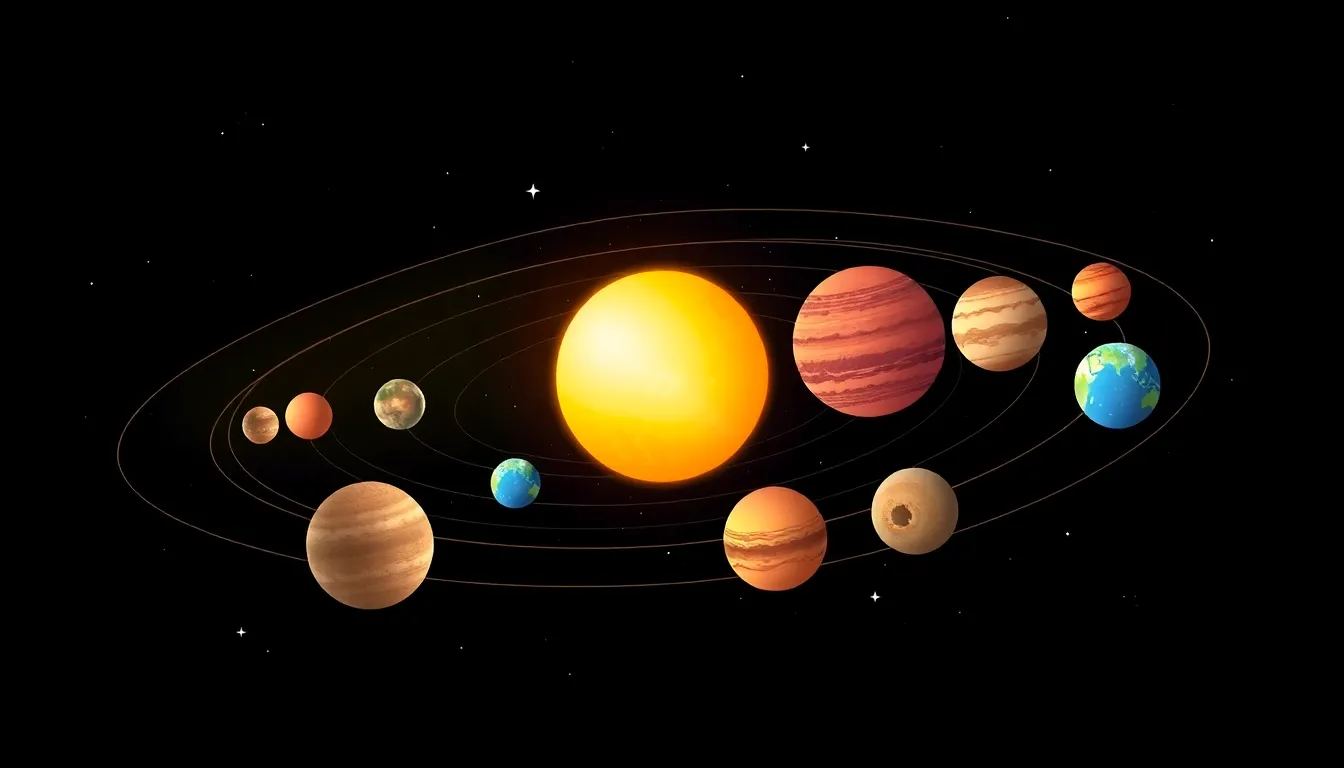
The solar system is a fascinating place filled with incredible celestial bodies. At its center lies the Sun, an essential source of light and energy.
The Sun
The Sun is a massive star and accounts for about 99.86% of the solar system’s total mass. It generates energy through nuclear fusion, producing heat and light that support life on Earth and influence planetary climates. The Sun’s gravity keeps the planets in orbit, creating stable paths around it. It has a surface temperature exceeding 5,500 degrees Celsius, making it extremely hot. Various solar phenomena, such as solar flares and sunspots, enhance its dynamic nature and create stunning displays observed from Earth.
The Planets
The solar system comprises eight unique planets, each with distinct characteristics. Mercury, being the closest planet to the Sun, has a rocky surface and experiences dramatic temperature changes. Venus, the second planet, envelops itself in thick, toxic clouds that trap heat, resulting in the hottest surface temperatures. Earth offers a habitable environment, featuring abundant water and diverse ecosystems. Mars, with its red color, showcases evidence of ancient water. Jupiter, the largest planet, boasts the Great Red Spot, a gigantic storm. Saturn captivates with its magnificent rings, while Uranus and Neptune, the outer giants, possess striking blue-green hues due to methane in their atmospheres. Each planet contributes to the diverse tapestry of the solar system, inviting exploration and discovery.
Order of Planets
The solar system consists of eight distinct planets, each unique. Here’s a closer look at their fascinating characteristics.
Mercury
Mercury ranks as the closest planet to the Sun. It features a rocky surface marked by craters from impacts. Temperatures on Mercury vary widely; during the day, they can reach 800°F, while nighttime temperatures can drop to -330°F. This extreme temperature fluctuation results from its thin atmosphere, which cannot retain heat. Time on Mercury runs differently, as a day lasts 59 Earth days, while a year takes just 88 Earth days.
Venus
Venus follows Mercury as the second planet from the Sun. Known for its thick, toxic atmosphere, it traps heat, making it the hottest planet at around 900°F. Venus boasts beautiful volcanic plains and vast mountains. The planet has no water, but it features sulfuric acid clouds that generate a greenhouse effect, intensifying its heat. A Venusian day lasts about 243 Earth days, which exceeds its 225-day year.
Earth
Earth holds the third position as the only planet known to support life. It features vast oceans, mountains, forests, and diverse ecosystems. The atmosphere contains essential gases, including oxygen and nitrogen, crucial for life. Earth’s distance from the Sun allows for moderate temperatures that sustain various weather patterns. Additionally, its axial tilt creates seasons, influencing climate and biodiversity across the planet.
Mars
Mars comes after Earth as the fourth planet, known for its striking red appearance. Iron oxide, or rust, covers its surface, giving the planet its color. Evidence suggests Mars once had water, leading to the possibility of past life. Exploration missions continue to study its landscape, revealing features like valleys and the tallest volcano, Olympus Mons. A day on Mars lasts about 24.6 hours, and a year takes roughly 687 Earth days.
Jupiter
Jupiter, the largest planet in the solar system, takes the fifth position. This gas giant is primarily composed of hydrogen and helium, with no solid surface. The Great Red Spot, a colossal storm, has persisted for hundreds of years and remains larger than Earth. Jupiter boasts at least 79 moons, including Ganymede, the largest moon in the solar system. A day lasts about 9.9 hours, while one year takes approximately 11.9 Earth years.
Saturn
Saturn ranks sixth and is famous for its stunning ring system. These rings consist of ice particles, rocky debris, and dust, creating a breathtaking display. Saturn suffers from high winds that can reach speeds of 1,100 mph. Its unique composition includes hydrogen and helium, providing a gaseous atmosphere. The planet also has numerous moons, with Titan being the most notable, featuring a thick atmosphere and liquid lakes.
Uranus
Uranus stands seventh in line from the Sun. It has a distinctive blue-green color due to methane gas in its atmosphere. An unusual trait is its tilted rotation axis, causing it to rotate on its side. Uranus has rings and 27 known moons, forming a captivating system. A day on Uranus lasts about 17.2 hours, while its year spans approximately 84 Earth years.
Neptune
Neptune is the eighth and farthest planet from the Sun. Known for its deep blue color, Neptune features the fastest winds in the solar system, reaching speeds of 1,500 mph. Its atmosphere contains hydrogen, helium, and methane, contributing to its vibrant hue. Neptune possesses several moons, with Triton being the largest. A day on Neptune lasts about 16 hours, while it takes roughly 165 Earth years to complete one orbit around the Sun.
Fun Facts About Each Planet
Mercury, the closest planet to the Sun, has no atmosphere, resulting in extreme temperature changes, ranging from scorching heat to freezing cold. Venus, enveloped in thick clouds, experiences a greenhouse effect, pushing temperatures to about 900 degrees Fahrenheit, making it the hottest planet. Earth’s unique ability to support life stems from its favorable atmosphere, abundant water, and protective magnetic field. Mars catches attention with its reddish appearance due to iron oxide or rust on its surface, along with evidence of ancient riverbeds.
Jupiter stands out as the largest planet with a diameter of 86,881 miles, 11 times wider than Earth. The Great Red Spot, a giant storm, has existed for over 350 years, demonstrating Jupiter’s dynamic atmosphere. Saturn captivates with its iconic rings made of ice and rock particles, stretching more than 170,000 miles across. The planet’s moon count is impressive, with at least 83 confirmed moons, Titan being the largest and bigger than the planet Mercury.
Uranus, often described as an ice giant, features a distinct blue-green hue from methane in its atmosphere. The planet rotates differently than others, lying on its side with an axial tilt of approximately 98 degrees. Neptune, the farthest planet, presents striking deep blue color due to its atmosphere’s composition and exhibits the fastest winds in the solar system, reaching speeds over 1,200 miles per hour. Fascinatingly, Neptune’s storms can change rapidly, reflecting its unpredictable nature. Each planet presents unique traits and continues to fuel interest in space exploration.
Exploring the planets in our solar system is a thrilling adventure for kids. Each planet offers its own unique features and mysteries waiting to be uncovered. From the scorching surface of Mercury to the icy rings of Saturn, there’s so much to learn and discover.
This journey not only ignites curiosity about space but also encourages a deeper understanding of our universe. As kids delve into the characteristics of each planet, they develop a sense of wonder and appreciation for the cosmos. The solar system is a vast playground of knowledge that inspires young minds to dream big and explore the unknown.